The National Flower was officially designated as the plum blossom by the Executive Yuan of the Republic of China (Taiwan) on July 21, 1964. The plum blossom, known as the meihua (Chinese: 梅花; pinyin: méihuā), is symbol for resilience and perseverance in the face of adversity, because plum blossoms often bloom most vibrantly even amidst the harsh winter snow. The triple grouping of stamens represents Dr. Sun Yat-sen's Three Principles of the People, while the five petals symbolize the five branches of the government.
 Prunus mume, with the common names including Chinese plum and Japanese apricot, is an Asian tree species classified in the Armeniaca section of the genus Prunus. The flower, long a beloved subject in the traditional painting of East Asia, is usually translated as plum blossom. This distinct tree species is related to both the plum and apricot trees. Although generally referred to as a plum in English, it is more closely related to the apricot.
Prunus mume originated in the south of China around the Yangtze River and was later brought to Taiwan, Korea, Vietnam, Laos, and Japan. It can be found in sparse forests, stream sides, forested slopes along trails and mountains, sometimes at altitudes up to 1700 to 3100 meter, and regions of cultivation.
Description
 Prunus mume is a deciduous tree that starts flowering in mid-winter, typically around January or February in East Asia. It can grow to 4–10 meters tall. The flowers are 2-2.5 cm in diameter and have a strong fragrant scent. The flowers have colors in varying shades of white, pink, and red. The leaves appear shortly after the petals fall. They are oval-shaped with a pointed tip, and are 4–8 cm long and 2.5–5 cm wide. The fruit ripens in early summer, around June and July in East Asia, and coincides with the rainy season of East Asia, the meiyu (梅雨, literally "plum rain"). The stone fruit is 2–3 cm in diameter with a groove running from the stalk to the tip. The skin turns yellow, sometimes with a red blush, as it ripens, and the flesh becomes yellow. The tree is cultivated for its fruit and flowers.
The plant is known by a number of different names in English, including Chinese plum and Japanese apricot. An alternative name is ume, from the Japanese pronunciation of the Chinese name, or mume, from the scientific name. Another alternative name is mei, from the Chinese name.
 The flower is known as the meihua (梅花), which came to be translated as "plum blossom" or sometimes as "flowering plum". The term "winter plum" may be used too, specifically with regard to the depiction of the flower with its early blooming in Chinese painting.
In Chinese it is called méi (梅) and the fruit is called méizi (梅子). The Japanese name is ume (kanji: 梅; hiragana: うめ), while the Korean name is maesil (hanja: 梅實). The Japanese and Korean terms derive from Middle Chinese, in which the pronunciation is thought to have been muəi. The Vietnamese name is mai or mơ (although mai may also refer to a different plant, Ochna integerrima, in the south of Vietnam).
Ornamental tree varieties and cultivars of P. mume have been cultivated for planting in various gardens throughout East Asia, and for cut blossoming branches used in flower arrangements.
Chinese varieties
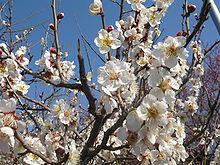
In China, there are over 300 recorded cultivars of Prunus mume. These are divided into three groups by phylogenetics (P. mume and hybrids). These are further classified by the type of branches: upright (直枝梅), pendulous (垂枝梅), and tortuous (龍游梅); and by the characteristics of the flower. Some varieties are especially famed for their ornamental value, including the dahongmei (big red mei), taigemei (pavilion mei), zhaoshuimei (reflecting water mei), lü'emei (green calyx mei), longyoumei (swimming dragon mei), and chuizhimei (weeping mei).
As the plum tree can usually grow for a long time, ancient trees are found throughout China. Huangmei county (Yellow Mei) in Hubei features a 1,600-year-old plum tree from the Jin Dynasty which is still flowering.
 Japanese varieties
In Japan, ornamental Prunus mume cultivars are classified into yabai (wild), hibai (red), and bungo (Bungo province) types. The bungo trees are also grown for fruit and are supposed to be hybrids between ume and apricot. The hibai trees have red heartwood and most of them have red flowers. The yabai trees are also used as grafting stock.
Mainland China
 The plum blossom, which is known as the meihua (梅花), is one of the most beloved flowers in China and have been frequently depicted in Chinese art and poetry for centuries. The plum blossom is seen as a symbol of winter and a harbinger of spring. The blossoms are so beloved because they are viewed as blooming most vibrantly amidst the winter snow, exuding a certain ethereal elegance, while their fragrance is noticed to still subtly pervade the air at even the coldest times of the year. Therefore the plum blossom came to symbolize perseverance and hope, but also beauty, purity, and the transitoriness of life. In Confucianism, the plum blossom stands for the principles and values of virtue. More recently, it has also been used as a metaphor to symbolize revolutionary struggle since the turn of the 20th century.
 Because it blossoms in the cold winter, the plum blossom (meihua) is regarded as one of the "Three Friends of Winter", along with pine, and bamboo. The plum blossom is also regarded as one of the "Four Gentlemen" of flowers in Chinese art (the others being orchid, chrysanthemum, and bamboo). It is one of the "Flowers of the Four Seasons", which consist of the orchid (spring), the lotus (summer), the chrysanthemum (autumn) and the plum blossom (winter). These groupings are seen repeatedly in the Chinese aesthetic of art, painting, literature, and garden design.
An example of the plum blossom's literary significance is found in the life and work of poet Lin Bu (林逋) of the Song Dynasty (960–1279). For much of his later life, Lin Bu lived in quiet reclusion on a cottage by West Lake in Hangzhou, China. According to stories, he loved plum blossoms and cranes so much that he considered the plum blossom of Solitary Hill at West Lake as his wife and the cranes of the lake as his children, thus he could live peacefully in solitude. One of his most famous poems is "Little Plum Blossom of Hill Garden" (山園小梅).
Taiwan
 The National Flower of the Republic of China was officially designated as the plum blossom (Prunus Mei; Chinese: 梅花) by the Executive Yuan of the Republic of China on July 21, 1964. The plum blossom is symbol for resilience and perseverance in the face of adversity during the harsh winter. The triple grouping of stamens (three stamens per petal) on the national emblem represents Dr. Sun Yat-sen's Three Principles of the People, while the five petals symbolize the five branches of the government. It also serves as the logo of China Airlines, the national carrier of the Republic of China. The flower is featured on some New Taiwan Dollar coins.






%E3%81%A8%E8%8A%9D%E6%A1%9C(%E3%81%97%E3%81%B0%E3%81%96%E3%81%8F%E3%82%89).jpg/190px-Sakura_and_Moss_Pink_-_%E6%A1%9C(%E3%81%95%E3%81%8F%E3%82%89)%E3%81%A8%E8%8A%9D%E6%A1%9C(%E3%81%97%E3%81%B0%E3%81%96%E3%81%8F%E3%82%89).jpg)


.jpg/220px-Nymphaea_'Jennifer_Rebecca'_(Landon,_1990).jpg)
.JPG/220px-Seerose_im_Botanischen_Garten_Erlangen_(4).JPG)


.jpg/220px-Bauhinia_blakeana_(Key_West).jpg)