Showing posts with label National Flowers in South-East Asia. Show all posts

National Flower of Myanmar - Padauk


Pterocarpus indicus (Pashu Padauk, Malay Paduak, New Guinea Rosewood, or, ambiguously, "Narra" which can refer to several Pterocarpus species) is a species of Pterocarpus native to southeastern Asia, northern Australasia, and the western Pacific Ocean islands, in Cambodia, southernmost China, East Timor, Indonesia, Malaysia, Papua New Guinea, the Philippines, the Ryukyu Islands, the Solomon Islands, Thailand, and Vietnam. Other names include Narra (Philippines), Sonokembang (Indonesia), Angsana or Sena (Indonesia, Malaysia and Singapore), Tnug (Cambodia).

Description
It is a large deciduous tree growing to 30–40 m tall, with a trunk up to 2 m diameter. The leaves are 12–22 cm long, pinnate, with 5–11 leaflets, the girth is 12-34 m wide. The flowers are produced in panicles 6–13 cm long containing a few to numerous flowers; flowering is from February to May in the Philippines, Borneo and the Malay peninsula. They are slightly fragrant and have yellow or orange-yellow petals. The fruit is a semiorbicular pod 2–3 cm diameter, surrounded by a flat 4–6 cm diameter membranaceous wing which aids dispersal by the water. It contains one or two seeds, and does not split open at maturity; it ripens within 4–6 years, and becomes purple when dry. The central part of the pod can be smooth (f. indica), bristly (f. echinatus (Pers.) Rojo) or intermediate. Most Pterocarpus species prefer seasonal weather but P. indicus prefer rainforests.

Note: Pterocarpus macrocarpus, a similar species native to Burma, is referred to as "Rosewood" throughout South East Asia. P. macrocarpus, is usually harder than P. indicus. When in burl form both are referred to as Amboyna Burl.

The hardwood, which is purplish, is termite resistant and rose-scented. The wood known in Indonesia as amboyna is the burl of the tree, named after Ambon, where much of this material was originally found. Often amboyna is finely sliced to produce an extremely decorative veneer, used for decoration and in making of furniture and keys on a marimba. The flower is used as a honey source while leaf infusions are used as shampoos. Both flowers and leaves were said to be eaten. The leaves are supposedly good for waxing and polishing brass and copper. The tree is recommended as an ornamental tree for avenues and is sometimes planted in Puerto Rico as a shade and ornament.

 It is also a source of kino or resin. In folk medicine, it is used to combat tumors. This property might be due to an acidic polypeptide found in its leaves that inhibited growth of Ehrlich ascites carcinoma cells by disruption of cell and nuclear membranes. It is also known as a diuretic in Europe during the 16th and 18th centuries. Its reputation may be due to its wood infusions, which are fluorescent. It is widely planted as a roadside, park, and car-park tree. The tall, dome-shaped crown, with long, drooping branches is very attractive and the flowers are spectacular in areas with a dry season. It is very easily propagated from seed or large stem cuttings, but suffers from disease problems.

Symbolism
It is the national tree of the Philippines, as well as the provincial tree of Chonburi and Phuket in Thailand.

Pterocarpus macrocarpus (Burma Padauk, Thai: ประดู่) is a species of Pterocarpus native to southeastern Asia in northeastern India, Burma, Laos, Thailand, and Vietnam.

It is a medium-sized tree growing to 10–30 m (rarely to 39 m) tall, with a trunk up to 1.7 m diameter; it is dry season-deciduous. The bark is flaky, grey-brown; if cut, it secretes a red gum. The leaves are 20–35 cm long, pinnate, with 9–11 leaflets. The flowers are yellow, produced in racemes 5–9 cm long. The fruit is a pod surrounded by a round wing 4.5–7 cm diameter, containing two or three seeds.

The wood is durable and resistant to termites; it is important, used for furniture, construction timber, cart wheels, tool handles, and posts; though not a true rosewood it is sometimes traded as such. Constituents of Pterocarpus marsupium have been reported to have beneficial properties for the treatment of type 2 diabetes.


Sources, Images: http://en.wikipedia.org/wiki/Pashu_Padauk, http://en.wikipedia.org/wiki/Burmese_Padauk

National Flower of Cambodia - Romduol


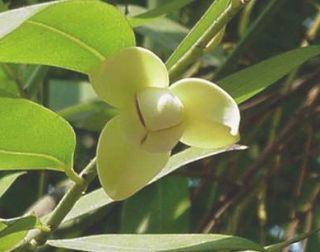
Mitrella mesnyi is a species of flowering plant in the soursop family, Annonaceae. In a 2005 royal decree by King Sihamoni of Cambodia, the rumdul or romduol (Thai: ลำดวน), as it is known in Cambodian, was proclaimed the national flower of Cambodia.

This plant has a yellowish-white flower with a single alternate leaf. It has a height of 8–12 m and a stem diameter of 20–30 cm. It gives out an attractive smell in the late afternoon and evening, a distinctive fragrance that can be smelled from a long distance.

The rumdul plant also bears edible fruits growing in clusters that will turn dark red when ripe. The rumdul is very common in Cambodia, where another flower known by the same name is Melodorum fruticosum.

White Cheesewood, Melodorum fruticosum, is a plant of the Annonaceae family native to South-East Asia. It is one of the two species considered the national flower of Cambodia. It is also the provincial flower of Sisaket Province, Thailand.

This plant has a cream-coloured flower with a single alternate leaf. It gives out a pleasant fragrance, especially in the evening. It also has medical uses as a tonic and mild cardiac stimulant and hematinic. This small tree reaches a height between 8 and 12 m. It is very common in Cambodia, where it is often planted as a decorative tree in public parks. Khmer women have been compared to the Rumdul flower in ancient Cambodian literature and folklore.


Source, Images: http://en.wikipedia.org/wiki/Melodorum_fruticosum, http://en.wikipedia.org/wiki/Romduol

National Flower of Laos - Champa


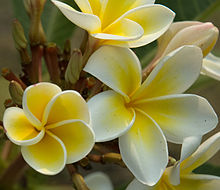
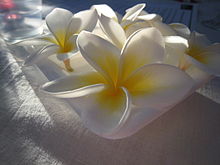
Laos national flower is the Plumeria (champa), despite it being no longer endemic.
Plumeria (common name Frangipani) is a genus of flowering plants of the family that includes Dogbane: the Apocynaceae. It contains 7-8 species of mainly deciduous shrubs and small trees. They are native to Mexico, Central America, the Caribbean, and South America as far south as Brazil but have been spread throughout the world's tropics.

Description
Plumeria is related to the Oleander, Nerium oleander, and both possess a irritating, milky sap, rather similar to that of Euphorbia. Contact with the sap may irritate eyes and skin. Each of the separate species of Plumeria bears differently shaped alternate leaves, with distinct form and growth habits. The leaves of P. alba are quite narrow and corrugated, whereas leaves of P. pudica have an elongated shape and glossy, dark-green color. P. pudica is one of the ever blooming types with non-deciduous, evergreen leaves. Another species that retains leaves and flowers in winter is P. obtusa; though its common name is "Singapore," it is originally from Colombia.

Plumeria flowers are most fragrant at night in order to lure sphinx moths to pollinate them. The flowers have no nectar, and simply dupe their pollinators. The moths inadvertently pollinate them by transferring pollen from flower to flower in their fruitless search for nectar.

Plumeria species may be easily propagated from cuttings of leafless stem tips in spring. Cuttings are allowed to dry at the base before planting in well-drained soil. Cuttings are particularly susceptible to rot in moist soil. Propagation can also be by tissue culture from cuttings of freshly elongated stems or aseptically germinated seed. Pruning is best accomplished in the winter for deciduous varieties, or when cuttings are desired.

There are more than 300 named varieties of Plumeria. The genus, originally spelled Plumiera, is named in honor of the seventeenth-century French botanist Charles Plumier, who traveled to the New World documenting many plant and animal species. The common name "Frangipani" comes from an Italian noble family, a sixteenth-century marquess who invented a plumeria-scented perfume. Many English speakers also simply use the generic name "plumeria". In Hawaii, the name is "melia". In Sri Lanka, it is referred to as araliya and (in English) as the Temple Tree.

In Culture
These are now common naturalized plants in southern and southeastern Asia. In local folk beliefs they provide shelter to ghosts and demons. The scent of the Plumeria has been associated with a vampire in Malay folklore, the pontianak. They are associated with temples in both Hindu and Buddhist cultures.

In several Pacific islands, such as Tahiti, Fiji, Samoa, Hawaii, New Zealand, Tonga, and the Cook Islands Plumeria species are used for making leis. In modern Polynesian culture, it can be worn by women to indicate their relationship status - over the right ear if seeking a relationship, and over the left if taken.

P. alba is the national flower of Nicaragua and Laos, where it is known under the local name "Sacuanjoche" (Nicaragua) and "Champa" (Laos).

In Bangladeshi culture most white flowers, and, in particular, plumeria (Bengali, chômpa or chãpa), are associated with funerals and death.

In the Philippines and Indonesia, Plumeria, which is known in Tagalog as calachuchi, is often associated with ghosts and graveyard. Plumerias are often planted on cemetery grounds in both countries. Balinese Hindus use the flowers in their temple offerings.

Indian incenses containing Plumeria have "Champa" in their name, for example Nag Champa.
In Hindu mythology, there is a saying “Hey Champa you have three qualities color, beauty, and fragrance, but the only thing you lack is that honey-bees never sit on you”; "roop tajey to Radhikey, or bhanwar Krishna ko daas, is mariyaadey ke liye bhanwar na aaye pass" (the beauty of champa is compared to Radhika, who is wife of lord Krishna and honey-bees are servants of Lord Krishna and this is the reason honey-bees don't sit on the champa flower.)

In Sri Lankan tradition, Plumeria is associated with worship. One of the heavenly damsels in the frescoes of the 5th-Century rock fortress Sigiriya holds a 5-petalled flower in her right hand that is indistinguishable from Plumeria. In Eastern Africa, frangipangi are sometimes referred to in Swahili love poems.


Source, Images: http://en.wikipedia.org/wiki/Plumeria

National Flower of Malaysia - Bunga Raya


The national flower of Malaysia is the Bunga Raya (Chinese Hibiscus, Hibiscus rosa-sinensis). The flower of the Eastern Malaysian state of Sarawak is the Phalaenopsis bellina, while that of the state of Kedah is the pokok padi.

Hibiscus rosa-sinensis, known colloquially as the Chinese hibiscus, China rose and shoe flower, is an evergreen flowering shrub native to East Asia.

It is widely grown as an ornamental plant throughout the tropics and subtropics. The flowers are large, generally red in the original varieties, and firm, but generally lack any scent. Numerous varieties, cultivars, and hybrids are available, with flower colors ranging from white through yellow and orange to scarlet and shades of pink, with both single and double sets of petals. Despite their size and red hues attractive to nectar-feeding birds, they are not visited regularly by hummingbirds when grown in the Neotropics. Generalists, like the Sapphire-spangled Emerald, Amazilia lactea, or long-billed species, like the Stripe-breasted Starthroat, Heliomaster squamosus, are occasionally seen to visit it, however. In the subtropical and temperate Americas, hummingbirds are attracted to them on a regular basis.

Hibiscus rosa-sinensis was named by Carolus Linnaeus. It has many names in Chinese: chijin, riji, fusang, fosang, hongfusang, hongmujin, sangjin, huohonghua, zhaodianhong, songjin, erhonghua, huashanghua, tuhonghua, jiamudan and zhongguoqiangwei. Each of these many names is from a different state in China, each state having its own name for the plant. It also has prominent presence in the various part of Indian subcontinent. It has several names in different languages,Jaswand in Marathi, Bengali: Jaba, Sembaruthi - in Tamil, Hindi: Chemparathy in Malayalam, Mondaro in Oriya, Wada Mal in Sinhala, Mamdaram in Telugu, Kembang Sepatu in Indonesia and Gumamela in Filipino.

National symbol
Hibiscus rosa-sinensis is the national flower of Malaysia, called Bunga Raya in Malay. Introduced into the Malay Peninsula in the 12th century, it was nominated as the national flower in the year 1958 by the Ministry of Agriculture amongst a few other flowers, namely ylang ylang, jasmine, lotus, rose, magnolia, and bunga tanjung. On 28 July 1960, it was declared by the government of Malaysia that the hibiscus would be the national flower.

The word bunga in Malay means "flower", whilst raya in Malay means "big" or "grand". The hibiscus is literally known as the "big flower" in Malay. The red of the petals symbolizes the courage, life, and rapid growth of the Malaysian, and the five petals represent the five Rukun Negara of Malaysia. The flower can be found imprinted on the notes and coins of the Malaysian ringgit.

Uses
Hibiscus flower preparations are used for hair care. The flowers themselves are edible and are used in salads in the Pacific Islands. The flowers are used to shine shoes in parts of India.It is also a pH indicator.China rose indicator turns acidic solutions to magenta/dark pink and basic solutions to green. It is also used for the worship of Devi and especially the red variety takes an important part in tantra. In Indonesia, these flowers are called "kembang sepatu", which literally means "shoe flower".

Hibiscus rosa-sinensis is considered to have a number of medical uses in Chinese herbology.

Hibiscus rosa-sinensis is one of many plant genera with a genetic characteristic known as polyploidy, in which there are more than two complete sets of chromosomes, unlike most other species including human. Polyploidy is a condition where the phenotype of the offspring may be quite different from the parent, or indeed any ancestor, essentially allowing possibly random expression of all (or any) of the characteristics of all the generations that have gone before. Because of this characteristic, H. rosa-sinensis has become popular with hobbyists who cross and recross varieties, creating new named varieties and holding competitions to exhibit and judge the many resulting new seedlings and often strikingly unique flowers. To add to the genetic opportunities, Hibiscus rosa-sinensis has been successfully hybridized with the cold-hardy Hibiscus moscheutos and several other North American Hibiscus species, producing cold-hardy hybrids.

Often the progeny of these crosses are sterile, but some are fertile, further increasing the complexity of variability and the possibility of a virtually unlimited number of eventual Hibiscus rosa-sinensis varieties. This further attracts the hobbyists, who have created local and international associations, societies, publications, and manuals to further this hobby, which is practiced with these tropical plants worldwide, including indoors in cold climates.


Source, Images: http://en.wikipedia.org/wiki/Hibiscus_rosa_sinensis

National Flower of the Philippines and Indonesia - Arabian Jasmine


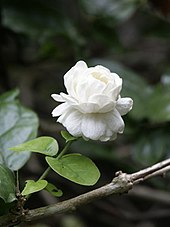
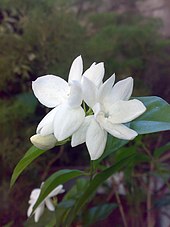
The Philippines adopted the Sampaguita (Arabian jasmine, Jasminum sambac) as its national flower because it symbolizes purity and cleanliness due to its colour and sweet odour.

Jasminum sambac is a species of jasmine native to South and Southeast Asia. It is a small shrub or vine growing up to 0.5 to 3 m (1.6 to 9.8 ft) in height. It is widely cultivated for its attractive and sweetly fragrant flowers. The flowers are also used for perfumes and for making tea. It is known as the Arabian jasmine in English. It is the national flower of the Philippines, where it is known as Sampaguita. It is also one of the three national flowers of Indonesia, where it is known as Melati Putih.

Jasminum sambac is classified under the genus Jasminum under the tribe Jasmineae. It belongs to the olive family Oleaceae.

Despite the English common name of "Arabian jasmine", Jasminum sambac is not originally native to Arabia. The habits of Jasminum sambac support a native habitat of humid tropical climates and not the arid climates of the Middle East. Early Chinese records of the plant points to the origin of Jasminum sambac as South and Southeast Asia. Jasminum sambac (and nine other species of the genus) were spread into Arabia and Persia by man, where they were cultivated in gardens. From there, they were introduced to Europe where they were grown as ornamentals and were known under the common name "sambac" in the 18th century. A name which is derived from a misapplication of the Sanskrit name champaka, which refers to the fragrant flowered shrub Michelia champaca.

In 1753, Carl Linnaeus first described the plant as Nyctanthes sambac in the first edition of his famous book Systema Naturae. In 1789, William Aiton reclassified the plant to the genus Jasminum. He also coined the common English name of "Arabian jasmine", cementing the misconception that it was Arabian in origin.

Description
Jasminum sambac is an evergreen vine or shrub reaching up to 0.5 to 3 m (1.6 to 9.8 ft) tall. The species is highly variable, possibly a result of spontaneous mutation, natural hybridization, and autopolyploidy. Only a few varieties reproduce by seed in the wild. Cultivated Jasminum sambac generally do not bear seeds and the plant is reproduced solely by cuttings, layering, marcotting, and other methods of asexual propagation.
The leaves are ovate, 4 to 12.5 cm (1.6 to 4.9 in) long and 2 to 7.5 cm (0.79 to 3.0 in) wide. The phyllotaxy is opposite or in whorls of three, simple (not pinnate, like most other jasmines). They are smooth (glabrous) except for a few hairs at the venation on the base of the leaf.

The flowers bloom all throughout the year and are produced in clusters of 3 to 12 together at the ends of branches. They are strongly scented, with a white corolla 2 to 3 cm (0.79 to 1.2 in) in diameter with 5 to 9 lobes. The flowers open at night (usually around 6 to 8 in the evening), and close in the morning, a span of 12 to 20 hours. The fruit is a purple to black berry 1 cm (0.39 in) in diameter.

The sweet, heady fragrance of Jasminum sambac is its distinct feature. It is widely grown throughout the tropics from the Arabian peninsula to Southeast Asia and the Pacific Islands as an ornamental plant and for its strongly scented flowers. Numerous cultivars currently exist.

Typically, the flowers are harvested as buds during early morning. The flower buds are harvested on basis of color, as firmness and size are variable depending on the weather. The buds have to be white, as green ones may not emit the characteristic fragrance they are known for. Open flowers are generally not harvested as a larger amount of them is needed to extract oils and they lose their fragrance sooner.

The Philippines
Jasminum sambac was adopted by the Philippines government as its national flower in 1934 by the then Governor General of the Philippines, Frank Murphy, through Proclamation No. 652. Filipinos string the flowers into leis, corsages, and crowns. These garlands are available as loose strings of blossoms or as tight clusters of buds. They are commonly sold by vendors outside churches and near stoplights.

Jasminum sambac was the subject of the danza song La Flor de Manila, composed by Dolores Paterno in 1879 at the age of 25. The song was popular during the American Commonwealth of the Philippines and is now regarded as a Philippine romantic classic.

Indonesia
Jasminum sambac (Indonesian: melati putih) is one of the three national flowers in Indonesia, the other two being the moon orchid and the giant padma. Although the official adoption were announced only as recent as 1990 during World Environment Day and enforced by law through Presidential Decree No. 4 in 1993, the importance of Jasminum sambac in Indonesian culture long predates its official adoption. Since the formation of Indonesian republic during the reign of Sukarno, melati putih is always unofficially recognized as the national flower of Indonesia. The reverence and its elevated status mostly due to the importance of this flower in Indonesian tradition since ancient times.

It has long been considered a sacred flower in Indonesian tradition, as it symbolizes purity, sacredness, graceful simplicity and sincerity. It also represents the beauty of modesty; a small and simple white flower that can produce such sweet fragrance. It is also the most important flower in wedding ceremonies for ethnic Indonesians, especially in the island of Java. Jasmine flower buds that have not fully opened are usually picked to create strings of jasmine garlands (Javanese: roncen melati ). On wedding days, a traditional Javanese or Sundanese bride's hair is adorned with strings of jasmine garlands arranged as a hairnet to cover the konde (hair bun). The intricately intertwined strings of jasmine garlands are left to hang loose from the bride's head. The groom's kris is also adorned with five jasmine garlands called roncen usus-usus (intestine garlands) to refer its intestine-like form and also linked to the legend of Arya Penangsang. In Makassar and Bugis brides, the hair is also adorned with buds of jasmine that resemble pearls. Jasmine is also used as floral offerings for hyangs, spirits and deities especially among Balinese Hindu, and also often present during funerals.

The jasmine has wide spectrums in Indonesian traditions; it is the flower of life, beauty and festive wedding, yet it is also often associated with spirit and death. In Indonesian patriotic songs and poems, the fallen melati often hailed as the representation of fallen heroes that sacrificed their life and died for the country, the very similar concept with fallen sakura that represent fallen heroes in Japanese tradition. The Ismail Marzuki's patriotic song "Melati di Tapal Batas" (jasmine on the border) (1947) and Guruh Sukarnoputra's "Melati Suci" (sacred jasmine) (1974) clearly refer jasmine as the representation of fallen heroes, the eternally fragrance flower that adorned Ibu Pertiwi (Indonesian national personification). The Iwan Abdurachman's "Melati dari Jayagiri" (jasmine from Jayagiri mountain) refer jasmine as the representation of the pure unspoiled beauty of a girl and also a long lost love.


Source, Images: http://en.wikipedia.org/wiki/Sampaguita

National Flower of Singapore - Vanda Miss Joaquim


The national flower for Singapore is the orchid Vanda Miss Joaquim.
Vanda Miss Joaquim (Chinese: zhuójǐn wàndàilán), also known as the Singapore Orchid' and the Princess Aloha Orchid is a hybrid orchid cultivar that is Singapore's national flower.

The flower is named after Agnes Joaquim who found the orchid in a clump of bamboo. An amateur historian has suggested that Miss Agnes Joaquim actually bred the orchid which bears her name. This suggestion is accepted only by a few hobby orchid growers. It was not, and is not accepted by orchid scientists because the available evidence does not support the intentional hybrid idea. The evidence suggests that Vanda Miss Joaquim is a natural hybrid between the Burmese Vanda teres and the Malayan Vanda hookeriana. It is not known which of the two species produced the seeds and which one provided the pollen. When hybrids are made intentionally these facts are known. They are not known for natural hybrids. The hybrid was shown to Henry Ridley, the director of the Singapore Botanic Gardens. Ridley examined it, had it sketched and sent a description to the Gardeners' Chronicle writing that: ‘A few years ago Miss Joaquim, a lady residing in Singapore, well-known for her success as a horticulturist, succeeded in crossing Vanda Hookeriana Rchb. f., and V. teres, two plants cultivated in almost every garden in Singapore.’


Source, Images: http://en.wikipedia.org/wiki/Vanda_Miss_Joaquim

National Flower of Thailand - Golden Shower Tree


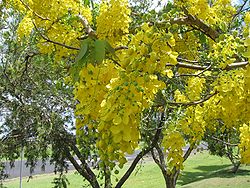
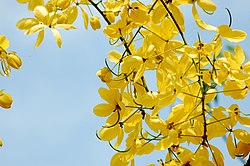
The national flower for Thailand is Golden Shower Tree, locally called dok khuen (Thai: ดอกคูน) or Rachapruek (Thai: ราชพฤกษ์).

Cassia fistula, known as the golden shower tree and other names, is a flowering plant in the family Fabaceae, native to southern Asia, from southern Pakistan east through India to Myanmar and south to Sri Lanka. It is the national tree of Thailand, and its flower is Thailand's national flower. It is also state flower of Kerala in India and of immense importance amongst Malayali population. It is a popular ornamental plant and is an herbal medicine.

Description
The golden shower tree is a medium-sized tree, growing to 10–20 m (33–66 ft) tall with fast growth. The leaves are deciduous, 15–60 cm (6–24 in) long, pinnate with 3–8 pairs of leaflets, each leaflet 7–21 cm (3–8 inches) long and 4–9 cm (1.5–3.5 in) broad. The flowers are produced in pendulous racemes 20–40 cm (8–15 in) long, each flower 4–7 cm diameter with five yellow petals of equal size and shape. The fruit is a legume, 30–60 cm (12–23 in) long and 1.5–2.5 cm (0.5–1 in) broad, with a pungent odor and containing several seeds. The seeds are poisonous. The tree has strong and very durable wood, and has been used to construct "Ahala Kanuwa", a place at Adams Peak, Sri Lanka, which is made of Cassia fistula ("ahala", "Ehela" or aehaela, in Sinhala) heartwood.

Cassia fistula is widely grown as an ornamental plant in tropical and subtropical areas. It blooms in late spring. Flowering is profuse, with trees being covered with yellow flowers, many times with almost no leaf being seen. It will grow well in dry climates. Growth for this tree is best in full sun on well-drained soil; it is relatively drought tolerant and slightly salt tolerant. It will tolerate light brief frost, but can get damaged if frost persists. It can be subject to mildew or leaf spot, especially during the second half of the growing season. The tree will bloom better where there is pronounced difference between summer and winter temperatures.

Medical use
In Ayurvedic medicine, golden shower tree is known as aragvadha, meaning "disease killer". The root is considered a very strong purgative, and self-medication or any use without medical supervision is strongly advised against in Ayurvedic texts.

Though its use in herbalism has been attested to for millennia, there has been rather little research in modern times. The purgative action is probably due to abundant 1,8-dihydroxyanthraquinone and derivatives thereof. Many Fabaceae are a source of potent entheogens and other psychoactive compounds, e.g. tryptamines; such plants are rarely found among the Caesalpinioideae. There is also a rare case of it being used for anal autoeroticism.

Culture
The golden shower tree is the national flower of Thailand; its yellow flowers symbolize Thai royalty. A 2006-2007 flower festival, the Royal Flora Ratchaphruek, was named after the tree, which is most often called dok khuen or ratchaphruek in Thailand. The golden shower tree is the state flower of Kerala in India. The flowers are of ritual importance in the Vishu festival of the Kerala state of India, and the tree was depicted on a 20 Indian rupees stamp. C. fistula is also featured on a 2003 joint Canadian-Thai design for a 48 cent stamp, part of a series featuring national emblems. Cassia acutifolia, the pudding-pipe tree, furnishes the cassia pods of commerce.


Source, Images: http://en.wikipedia.org/wiki/Golden_Shower_Tree

National Flower of Vietnam - Red Lotus


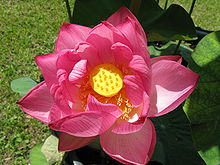
Nelumbo nucifera, known by a number of names including Indian Lotus, Sacred Lotus, Bean of India, or simply Lotus, is a plant in the monogeneric family Nelumbonaceae. The Linnaean binomial Nelumbo nucifera (Gaertn.) is the currently recognized name for this species, which has been classified under the former names, Nelumbium speciosum (Willd.) and Nymphaea nelumbo, among others. Names other than Nelumbo nucifera (Gaertn.) are obsolete synonyms and should not be used in current works. This plant is an aquatic perennial. Under favorable circumstances its seeds may remain viable for many years, with the oldest recorded lotus germination being from that of seeds 1,300 years old recovered from a dry lakebed in northeastern China.

A common misconception is referring to the lotus as a water lily (Nymphaea), an entirely different plant as can be seen from the center of the flower, which clearly lacks the structure that goes on to form the distinctive circular seed pod in the Nelumbo nucifera. Water lilies come in various colors, whereas the lotus has flowers ranging in hues of white to hot pink.

Native to Tropical Asia and Queensland, Australia, it is commonly cultivated in water gardens. The white and pink lotuses are national flowers of India and Vietnam, respectively.

Plant taxonomy systems agree that this flower is in the Nelumbo genus, but disagree as to which family Nelumbo is in, or whether it should be part of its own unique family and order tree. The roots of Nelumbo nucifera are planted in the soil of the pond or river bottom, while the leaves float on top of the water surface or are held well above it. The flowers are usually found on thick stems rising several centimeters above the leaves. The plant normally grows up to a height of about 150 cm and a horizontal spread of up to 3 meters, but some unverified reports place the height as high as over 5 meters. The leaves may be as large as 60 cm in diameter, while the showy flowers can be up to 20 cm in diameter.

Researchers report that the lotus has the remarkable ability to regulate the temperature of its flowers to within a narrow range just as humans and other warm blooded animals do. Dr. Roger S. Seymour and Dr. Paul Schultze-Motel, physiologists at the University of Adelaide in Australia, found that lotus flowers blooming in the Adelaide Botanic Gardens maintained a temperature of 30–35 °C (86–95 °F), even when the air temperature dropped to 10 °C (50 °F). They suspect the flowers may be doing this to attract coldblooded insect pollinators. The study, published in the journal Nature, is the latest discovery in the esoteric field of heat-producing plants. Two other species known to be able to regulate their temperature include Symplocarpus foetidus and Philodendron selloum.

The traditional Sacred Lotus is distantly related to Nymphaea caerulea and possesses similar chemistry. Both Nymphaea caerulea and Nelumbo nucifera contain the alkaloids nuciferine and aporphine.

The distinctive dried seed heads, which resemble the spouts of watering cans, are widely sold throughout the world for decorative purposes and for dried flower arranging.

The flowers, seeds, young leaves, and "roots" (rhizomes) are all edible. In Asia, the petals are sometimes used for garnish, while the large leaves are used as a wrap for food, not frequently eaten. In Korea, the leaves and petals are used as a tisane. Yeonkkotcha is made with dried petals of white lotus and yeonipcha is made with the leaves. Young lotus stems are used as a salad ingredient in Vietnamese cuisine. The rhizome is used as a vegetable in soups, deep-fried, stir-fried, and braised dishes and the roots are also used in traditional Asian herbal medicine. Petals, leaves, and rhizome can also all be eaten raw, but there is a risk of parasite transmission, it is therefore recommended that they be cooked before eating.

Lotus rootlets are often pickled with rice vinegar, sugar, chili and/or garlic. It has a crunchy texture with sweet-tangy flavours. In Asian cuisine, it is popular with salad, prawns, sesame oil and/or coriander leaves. Lotus roots have been found to be rich in dietary fiber, vitamin C, potassium, thiamin, riboflavin, vitamin B6, phosphorus, copper, and manganese, while very low in saturated fat.

The stamens can be dried and made into a fragrant herbal tea called liánhuā cha in Chinese, or (particularly in Vietnam) used to impart a scent to tea leaves. The lotus seeds or nuts are quite versatile, and can be eaten raw or dried and popped like popcorn, phool makhana. They can also be boiled until soft and made into a paste, or boiled with dried longans and rock sugar to make a tong sui (sweet soup). Combined with sugar, lotus seed paste becomes one of the most common ingredients used in pastries such as moon cakes, daifuku, and rice flour pudding.

In Vietnam, the bitter tasting germs of the lotus seeds are also made into a tisane (trà tim sen). A unique fabric from the lotus plant fibers is produced only at Inle lake, Union of Myanmar and is used for weaving special robes for Buddha images called kya thingahn (lotus robe).


Source, Images: http://en.wikipedia.org/wiki/Nelumbo_nucifera