Showing posts with label National Flowers in Western Asia. Show all posts

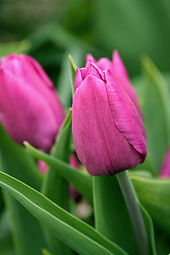
National Flower of Turkey - Tulip


The tulip is a perennial, bulbous plant with showy flowers in the genus Tulipa, which comprises 109 species and belongs to the family Liliaceae. The genus's native range extends from as far west as Southern Europe, North Africa, Anatolia, and Iran to the Northwest of China. The tulip's centre of diversity is in the Pamir, Hindu Kush, and Tien Shan mountains. A number of species and many hybrid cultivars are grown in gardens, as potted plants, or to display as fresh-cut flowers. Most cultivars of tulip are derived from Tulipa gesneriana.

Description
Tulips are spring-blooming perennials that grow from bulbs. Depending on the species, tulip plants can grow as short as 4 inches (10 cm) or as high as 28 inches (71 cm). The tulip's large flowers usually bloom on scapes or subscapose stems that lack bracts. Most tulips produce only one flower per stem, but a few species bear multiple flowers on their scapes (e.g. Tulipa turkestanica). The showy, generally cup- or star-shaped tulip flower has three petals and three sepals, which are often termed tepals because they are nearly identical. These six tepals are often marked near the bases with darker colorings. Tulip flowers come in a wide variety of colors, except pure blue (several tulips with "blue" in the name have a faint violet hue).
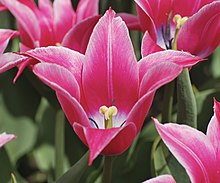
The flowers have six distinct, basifixed stamens with filaments shorter than the tepals. Each stigma of the flower has three distinct lobes, and the ovaries are superior, with three chambers. The tulip's fruit is a capsule with a leathery covering and an ellipsoid to subglobose shape. Each capsule contains numerous flat, disc-shaped seeds in two rows per chamber. These light to dark brown seeds have very thin seed coats and endosperm that does not normally fill the entire seed.

Tulip stems have few leaves, with larger species tending to have multiple leaves. Plants typically have 2 to 6 leaves, with some species having up to 12. The tulip's leaf is strap-shaped, with a waxy coating, and leaves are alternately arranged on the stem. These fleshy blades are often bluish green in color.

Origin of the name
Although tulips are often associated with The Netherlands, commercial cultivation of the flower began in the Ottoman Empire. The tulip, or lale (from Persian) as it is also called in Iran and Turkey, is a flower indigenous to a vast area encompassing arid parts of Africa, Asia, and Europe. The word tulip, which earlier appeared in English in forms such as tulipa or tulipant, entered the language by way of French tulipe and its obsolete form tulipan or by way of Modern Latin tulīpa, from Ottoman Turkish tülbend ("muslin" or "gauze"), and is ultimately derived from Persian dulband ("round").

Tulips are indigenous to mountainous areas with temperate climates and need a period of cool dormancy, known as vernalization. They thrive in climates with long, cool springs and dry summers. Although perennials, tulip bulbs are often imported to warm-winter areas of the world from cold-winter areas, and are planted in the fall to be treated as annuals.

Tulip bulbs are typically planted around late summer and fall, in well-drained soils, normally from 4 inches (10 cm) to 8 inches (20 cm) deep, depending on the type planted. In parts of the world that do not have long cool springs and dry summers, the bulbs are often planted up to 12 inches (300 mm) deep. This provides some insulation from the heat of summer, and tends to encourage the plants to regenerate one large, floriferous bulb each year, instead of many smaller, non-blooming ones. This can extend the life of a tulip plant in warmer-winter areas by a few years, but it does not stave off degradation in bulb size and the eventual death of the plant due to the lack of vernalization.

Tulips can be propagated through bulb offsets, seeds or micro-propagation. Offsets and tissue culture methods are means of asexual propagation for producing genetic clones of the parent plant, which maintains cultivar genetic integrity. Seed-raised plants show greater genetic variation, and seeds are most often used to propagate species and subspecies or to create new hybrids. Many tulip species can cross-pollinate with each other, and when wild tulip populations overlap geographically with other tulip species or subspecies, they often hybridize and create genetically mixed populations. On the other hand, most commercial tulip cultivars are complex hybrids, and actually sterile. Those hybrid plants that do produce seeds most often have offspring dissimilar to the parents.

Growing salable tulips from offsets requires a year or more of growth before plants are large enough to flower. Tulips grown from seeds often need five to eight years of growth before plants are flowering size. Commercial growers usually harvest the tulip bulbs in late summer and grade them into sizes; bulbs large enough to flower are sorted and sold, while smaller bulbs are sorted into sizes and replanted, for sale in the future. Holland is the world's main producer of commercially sold tulip plants, producing as many as 3 billion bulbs annually, the majority for export.

In art and culture
During the Ottoman Empire, the tulip became very popular in Ottoman territories and was seen as a symbol of abundance and indulgence. In fact, the era during which the Ottoman Empire was wealthiest is often called the Tulip era or Lale Devri in Turkish.

In classic and modern Persian literature, special attention has been given to these beautiful flowers, and in recent times, tulips have featured in the poems of Simin Behbahani. However, the tulip was a topic for Persian poets as far back as the thirteenth century. Musharrifu'd-din Saadi, in his poem Gulistan, described a visionary, garden paradise with 'The murmur of a cool stream / bird song, ripe fruit in plenty / bright multicoloured tulips and fragrant roses...'

The Black Tulip is the title of a historical romance by the French author Alexandre Dumas, père. The story takes place in the Dutch city of Haarlem, where a reward is offered to the first grower who can produce a truly black tulip.

Today, Tulip festivals are held around the world, including in The Netherlands, Spalding, England. Every spring, there are several tulip festivals in North America, including the Tulip Time Festival in Holland, Michigan, the Skagit Valley Tulip Festival in Skagit Valley, Washington, the Tulip Time Festival in Orange City and Pella, Iowa, and the Canadian Tulip Festival in Ottawa, Canada. Tulips are now also popular in Australia and several festivals are held in September and October, during the Southern Hemisphere's spring.


Source, Images: http://en.wikipedia.org/wiki/Tulip

National Flower of Kuwait - Arfaj


Rhanterium epapposum is a plant of the Asteraceae family. Native to the deserts of Saudi Arabia and Kuwait where it is known locally as Arfaj. The Arfaj plant consists of a complicated network of branches scattered with small thorny leaves and bright yellow flowers about 1.5 cm wide. The Arfaj flower is also the national flower of Kuwait. It is a very bushy shrub approximately 80 cm height. The leaves are small and narrow, and in late spring it will start flowering (April-May). It is considered one of the main desert forage plants for camels and sheep.

When cold temperature prevails the Rhanterium produces leaves quickly after rainfall. In a few months, the branches and newly formed leaves become vigorous, and the brownish yellow flower become enormous, attracting insects and birds. In the summer, when the earth has dried out, the leaves fall and the branches become naked and lignified with living fibers. In times of stress, these alterations may be important in increasing the chance of survival, water and reserve material stored in the stems to remain alive by allowing it to have few dormant bud. When conditions improve, the reserves are transported into buds allowing new growth.
Arfaj fruit is numerous; it forms in late spring and falls off the branches after maturity. It accumulates under the shrub and remains dormant until favorable conditions for germination prevail. Each fruit contains about 6-8 seeds that are transported by wind or water.


Source, Images: http://en.wikipedia.org/wiki/Rhanterium_epapposum

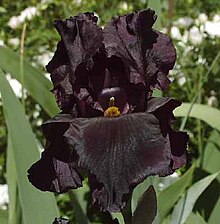
National Flower of Jordan - Black Iris


Iris chrysographes, commonly known as the Black Iris, is a plant species that belongs to the genus Iris. It is native to S China and Myanmar (Burma), growing in meadows, stream sides, hillsides and forest margins. Other irises known as the Black Iris include Iris nigricans which is the national flower of Jordan, Iris petrana which also grows in Jordan, and Iris susiana.

Horticultural classification: Sino-Siberian Iris, Beardless Iris. Herbaceous perennial with creeping rhizomes. Leaves linear and grayish green, to 70 cm long. Flowering stems 25–50 cm, hollow. Flowers reddish violet to very dark violet, almost velvety black, 6–9 cm in diameter, outer tepals usually with golden yellow stripes. Deliciously fragrant flowers are in June to July.

Iris chrysographes is easily cultivated and requires a fertile soil which does not dry out during the growth period. Grow in full sun. Hardy to USDA zone 4. Propagation by seeds or division in the spring. Cultivars must be divided. For cooler areas plants do best if planted in the spring.

Some cultivars are grown, mainly "black" flowered clones under names as 'Black Beauty', 'Black Knight', 'Black' (syn. 'Black Form', an invalid name), 'Ellenbank Nightshade', 'Stjerneskud' and 'Kew Black'. 'Rubella' is purplish violet. Iris chrysographes has been used in a number of hybrids with other species.


Source, Images: http://en.wikipedia.org/wiki/Black_Iris

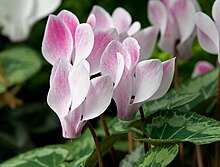
National Flower of Israel - Rakefet (Cyclamen)


Cyclamen is a genus of 23 species of perennials growing from tubers, valued for their flowers with upswept petals and variably patterned leaves. Cyclamen species are native from Europe and the Mediterranean region east to Iran, with one species in Somalia. It was traditionally classified in the family Primulaceae but recently has been reclassified in the family Myrsinaceae.

Cyclamen is Medieval Latin, from earlier Latin cyclamīnos, from Ancient Greek kyklā́mīnos (also kyklāmī́s), probably from kýklos "circle", because of the round tuber. In English, the species of the genus are commonly called by the genus name.

In many languages, cyclamen species are colloquially called by a name like the English sowbread, because they are said to be eaten by pigs: pain de pourceau in French, pan porcino in Italian, varkensbrood in Dutch. Sometimes they are called Persian violet or primrose, although it is unrelated to the violets and is not a primrose (Primula).

Description
Cyclamens have a tuber, from which the flowers and roots grow. In most species, leaves come up in autumn, grow through the winter, and die in spring, then the plant goes dormant through the dry Mediterranean summer.

Tuber
The storage organ of the cyclamen is a round and somewhat flattened tuber; it develops from the hypocotyl (the stem of a seedling).

The cyclamen storage organ is often informally called a corm. In botany, a corm (found in crocuses) is defined as having a papery tunic and a basal plate from which the roots grow, but the storage organ of the cyclamen has no papery covering and, depending on the species, roots may grow out of any part. Therefore, the cyclamen's storage organ is properly classified as a tuber (somewhat like a potato).

The tuber may produce roots from the top, sides, or bottom, depending on the species. Cyclamen persicum and Cyclamen coum root from the bottom; Cyclamen hederifolium roots from the top and sides. Cyclamen graecum has thick anchor roots on the bottom. Leaves and flowers sprout in rosettes from growing points on the top of the tuber. If the growing points lengthen and become like woody stems, they are known as floral trunks.

In older specimens of Cyclamen purpurascens and Cyclamen rohlfsianum, growing points on the tuber may become separated by shoulders of tissue, and the tuber may become misshapen. In most other species, the tuber is round in old age. The size of the tuber varies depending on species. In Cyclamen hederifolium, older tubers commonly reach 24 cm (9.4 in) across, but in Cyclamen parviflorum, tubers do not grow larger than 2 cm (1 in) across.

Flowers
Flowering time may be any month of the year, depending on the species. Cyclamen hederifolium and Cyclamen purpurascens bloom in summer and autumn, Cyclamen persicum and coum bloom in winter, and Cyclamen repandum blooms in spring.
Each flower is on a stem coming from a growing point on the tuber. In all species, the stem is bent 150-180° at the tip, so that the nose of the flower faces downwards. Flowers have 5 petals, bent outwards or up, sometimes twisted, and connected at the base into a cup, and five sepals behind the cup.

Petal shape varies depending on species, and sometimes within the same species. Cyclamen repandum has petals much longer than wide, Cyclamen coum has stubby, almost round petals, and Cyclamen hederifolium usually has petals with proportions between the two. Petal color may be white, pink, or purple, often with darker color on the nose. Many species have a pink form and a white form, but a few have only one color, such as Cyclamen balearicum, which is always white.

The dark color on the flower nose varies in shape: Cyclamen persicum has a smooth band, Cyclamen hederifolium has a streaky V, and Cyclamen coum has an M-shaped splotch with two white or pink "eyes" beneath.

In some species, such as Cyclamen hederifolium, the petal edges at the nose are curved outwards into auricles (Latin for "little ears"). Most species, like Cyclamen persicum, have no auricles. In most species, the style protrudes 1–3 mm out of the nose of the flower, but the stamens are inside the flower. In Cyclamen rohlfsianum, however, the cone of anthers sticks out prominently, about 2–3 mm (0.08–0.12 in) beyond the rim of the corolla, similar to shooting-stars (Dodecatheon).

The flower stem coils or bends when the fruit begins to form. The stems of Cyclamen hederifolium and Cyclamen coum coil starting at the end, Cyclamen persicum arches downwards but does not curl, Cyclamen rohlfsianum coils starting near the tuber, and Cyclamen graecum coils both directions, starting at the middle.

The fruit is a round pod that opens by several flaps or teeth at maturity and contains numerous sticky seeds, brown at maturity. Natural seed dispersal is by ants (myrmecochory), which eat the sticky covering and then discard the seeds.

Cultivation and uses
Cyclamen are commonly grown for their flowers, both outdoors and indoors in pots. Several species, particularly Cyclamen hederifolium, are hardy and can be grown outdoors in mild climates such as northwest Europe and the Pacific Northwest of North America.

The cyclamen commonly sold by florists is C. persicum, which is frost-tender. Selected cyclamen cultivars can have white, bright pink, red or purple flowers. While flowering, florists' cyclamens should be kept below 20 °C (68 °F), with the night time temperatures preferably between 6.5 °C to 15 °C (44 °F to 59 °F). Temperatures above 20 °C (68 °F) may induce the plant to go dormant. Cyclamens bloom in different seasons, depending on the species.

Conservation
In many areas within the native range, cyclamen populations have been severely depleted by collection from the wild, often illegally, for the horticultural trade; some species are now endangered as a result. However, in a few areas, plant conservation charities have educated local people to control the harvest carefully at a sustainable level, including sowing seed for future crops, both sustaining the wild populations and producing a reliable long-term income. Many cyclamen are also propagated in nurseries without harm to the wild plants.


Source, Images: http://en.wikipedia.org/wiki/Cyclamen

National Flower of Cyprus - Cyprus cyclamen


Cyclamen cyprium (Cyprus cyclamen) is a perennial growing from a tuber, native to woodland at 300–1,200 m (980–3,900 ft) elevation in the mountains of Cyprus. It is the national flower. Cyclamen persicum and Cyclamen graecum are also found on Cyprus, but are not endemic.

Description
Leaves are heart-shaped with coarsely toothed edges, green variegated with blotches of silver above and purple beneath.

Flowers bloom in autumn to winter, and have 5 upswept petals, white to pale pink with a magenta blotch near the nose. The bases of the petals curve outwards into auricles. After pollination, flower stems curl, and seeds are borne in round pods, opening by 5 flaps when mature.

Cyclamen ×wellensiekii Iets. is a hybrid obtained in 1969 in the Netherlands between this species and Cyclamen libanoticum – the other species of sub-genus Corticata. This fertile hybrid has pink flowers from November till March.


Source, Images: http://en.wikipedia.org/wiki/Cyprus_cyclamen

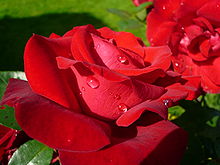
National Flower of Iraq - Rose


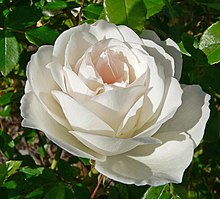
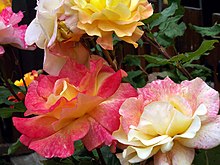
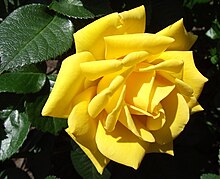
A rose is a woody perennial of the genus Rosa, within the family Rosaceae. There are over 100 species. They form a group of erect shrubs, and climbing or trailing plants, with stems that are often armed with sharp prickles. Flowers are large and showy, in colours ranging from white through yellows and reds. Most species are native to Asia, with smaller numbers native to Europe, North America, and Northwest Africa. Species, cultivars and hybrids are all widely grown for their beauty and fragrance. Rose plants range in size from compact, miniature roses, to climbers that can reach 7 meters in height. Different species hybridize easily, and this has been used in the development of the wide range of garden roses.

The name rose comes from French, itself from Latin rosa, which was perhaps borrowed from Oscan, from Greek ρόδον rhodon (Aeolic βρόδον wrodon), related to Old Persian wrd-, Avestan varəda, Sogdian ward, Parthian wâr, Armenian vard.

The leaves are borne alternately on the stem. In most species they are 5 to 15 centimetres (2.0 to 5.9 in) long, pinnate, with (3–) 5–9 (–13) leaflets and basal stipules; the leaflets usually have a serrated margin, and often a few small prickles on the underside of the stem. Most roses are deciduous but a few (particularly from Southeast Asia) are evergreen or nearly so.

The flowers of most species have five petals, with the exception of Rosa sericea, which usually has only four. Each petal is divided into two distinct lobes and is usually white or pink, though in a few species yellow or red. Beneath the petals are five sepals (or in the case of some Rosa sericea, four). These may be long enough to be visible when viewed from above and appear as green points alternating with the rounded petals. There are multiple superior ovaries that develop into achenes. Roses are insect-pollinated in nature.

The aggregate fruit of the rose is a berry-like structure called a rose hip. Many of the domestic cultivars do not produce hips, as the flowers are so tightly petalled that they do not provide access for pollination. The hips of most species are red, but a few (e.g. Rosa pimpinellifolia) have dark purple to black hips. Each hip comprises an outer fleshy layer, the hypanthium, which contains 5–160 "seeds" (technically dry single-seeded fruits called achenes) embedded in a matrix of fine, but stiff, hairs. Rose hips of some species, especially the Dog Rose (Rosa canina) and Rugosa Rose (Rosa rugosa), are very rich in vitamin C, among the richest sources of any plant. The hips are eaten by fruit-eating birds such as thrushes and waxwings, which then disperse the seeds in their droppings. Some birds, particularly finches, also eat the seeds.

While the sharp objects along a rose stem are commonly called "thorns", they are technically prickles — outgrowths of the epidermis (the outer layer of tissue of the stem). (True thorns, as produced by e.g. Citrus or Pyracantha, are modified stems, which always originate at a node and which have nodes and internodes along the length of the thorn itself.) Rose prickles are typically sickle-shaped hooks, which aid the rose in hanging onto other vegetation when growing over it. Some species such as Rosa rugosa and Rosa pimpinellifolia have densely packed straight spines, probably an adaptation to reduce browsing by animals, but also possibly an adaptation to trap wind-blown sand and so reduce erosion and protect their roots (both of these species grow naturally on coastal sand dunes). Despite the presence of prickles, roses are frequently browsed by deer. A few species of roses have only vestigial prickles that have no points.

Roses are best known as ornamental plants grown for their flowers in the garden and sometimes indoors. They have been also used for commercial perfumery and commercial cut flower crops. Some are used as landscape plants, for hedging and for other utilitarian purposes such as game cover and slope stabilization. They also have minor medicinal uses.

Ornamental plants
The majority of ornamental roses are hybrids that were bred for their flowers. A few, mostly species roses are grown for attractive or scented foliage (such as Rosa glauca and Rosa rubiginosa), ornamental thorns (such as Rosa sericea) or for their showy fruit (such as Rosa moyesii).

Ornamental roses have been cultivated for millennia, with the earliest known cultivation known to date from at least 500 BC in Mediterranean countries, Persia, and China. Many thousands of rose hybrids and cultivars have been bred and selected for garden use as flowering plants. Most are double-flowered with many or all of the stamens having mutated into additional petals.

In the early 19th century the Empress Josephine of France patronized the development of rose breeding at her gardens at Malmaison. As long ago as 1840 a collection numbering over one thousand different cultivars, varieties and species was possible when a rosarium was planted by Loddiges nursery for Abney Park Cemetery, an early Victorian garden cemetery and arboretum in England.

A few species and hybrids are grown for non-floral ornamental use. Among these are those grown for prominent hips, such as the flagon shaped hips of Rosa moyesii. Sometimes even the thorns can be treated as an attraction or curiosity, such as with Rosa sericea.

Cut flowers
Roses are a popular crop for both domestic and commercial cut flowers. Generally they are harvested and cut when in bud, and held in refrigerated conditions until ready for display at their point of sale.

In temperate climates, cut roses are often grown in glasshouses, and in warmer countries they may also be grown under cover in order to ensure that the flowers are not damaged by weather and that pests and disease control can be carried out effectively. Significant quantities are grown in some tropical countries, and these are shipped by air to markets across the world.

Perfume
Rose perfumes are made from attar of roses or rose oil, which is a mixture of volatile essential oils obtained by steam distilling the crushed petals of roses. An associated product is rose water which is used for cooking, cosmetics, medicine and in religious practices. The production technique originated in Persia then spread through Arabia and India, and more recently into eastern Europe. In Bulgaria, Iran and Germany, damask roses (Rosa damascena 'Trigintipetala') are used. In other parts of the world Rosa centifolia is commonly used. The oil is transparent pale yellow or yellow-grey in colour. 'Rose Absolute' is solvent-extracted with hexane and produces a darker oil, dark yellow to orange in colour. The weight of oil extracted is about one three-thousandth to one six-thousandth of the weight of the flowers; for example, about two thousand flowers are required to produce one gram of oil.

The main constituents of attar of roses are the fragrant alcohols geraniol and l-citronellol; and rose camphor, an odourless paraffin. β-Damascenone is also a significant contributor to the scent. Rose water, made as a byproduct of rose oil production, is widely used in Asian and Middle Eastern cuisine. In France there is much use of rose syrup, most commonly made from an extract of rose petals. In the United States, this French rose syrup is used to make rose scones and marshmallows.

Rose hips
The rose hip, the fruit of some species, is used as a minor source of Vitamin C. Rose hips are occasionally made into jam, jelly, and marmalade, or are brewed for tea, primarily for their high vitamin C content. They are also pressed and filtered to make rose hip syrup. Rose hips are also used to produce Rose hip seed oil, which is used in skin products and some makeup products.

The fruits of many species have significant levels of vitamins and have been used as a food supplement (see previous section). Many roses have been used in herbal and folk medicines. Rosa chinensis has long been used in Chinese traditional medicine. This and other species have been used for stomach problems, and are being investigated for controlling cancer growth.

Culture
Roses are a favored subject in art and therefore used in various artistic disciplines. They appear in portraits, illustrations, on stamps, as ornaments or as architectural elements. The Luxembourg born Belgian artist and botanist Pierre-Joseph Redouté is known for his detailed water colours of flowers, particularly roses.

Henri Fantin-Latour was also a prolific painter of still life, particularly flowers including roses. The Rose 'Fantin-Latour' was named after the artist. Other impressionists including Claude Monet, Paul Cézanne and Pierre-Auguste Renoir have paintings of roses among their works. The long cultural history of the rose has led to it being used often as a symbol.


Source, Images: http://en.wikipedia.org/wiki/Rose