Balsamine - Impatience


Balsamine meaning: Impatience

Impatiens is a genus of about 850–1,000 species of flowering plants, widely distributed throughout the Northern Hemisphere and tropics. Together with the puzzling Hydrocera triflora, this genus makes up the family Balsaminaceae. Such a situation is highly unusual, and phylogenetic studies might reveal that Impatiens needs to be split up; some of its species might be closer to Hydrocera than to their presumed congeners.

Common names include impatiens, jewelweeds, and, somewhat ambiguously, "balsams" and "touch-me-nots". As a rule-of-thumb, "jewelweed" is used exclusively for Nearctic species, "balsam" is usually applied to tropical species, and "touch-me-not" is typically used in Europe and North America. Some species commonly planted in horticulture have altogether more fanciful names, such as "Busy Lizzie" (the well-known I. walleriana).

Description
Some species are annual plants and produce flowers from early summer until the first frost, while perennial species, found in milder climates, can flower all year. Regardless of their lifespan, the largest impatiens grow up to about 2 meters (c. 7 ft) tall, but most are less than half as tall. The leaves are entire and shiny; their upperside has a thick, water-repellent cuticula that gives them a greasy feel. Particularly on the underside of the leaves, tiny air bubbles are trapped under the leaf surface, giving them a silvery sheen that becomes pronounced when held under water. The name "jewelweed" possibly refers to these shiny leaves, particularly obvious after rains when water drops reflect the sunlight like a prism. However it is more likely that the name is derived from the robin egg blue of the surface of the seed beneath the dark brown aril, or seed coat.

The flowers, up to 2–3 cm, around 1 inch long, in most species are made up by a shoe- or horn-shaped spur for the most part, with at least the upper petals insignificant by comparison; some have a prominent labellum though, allowing pollinators to land. Others, like the Busy Lizzie (I. walleriana), have flattened flowers with large petals and just a tiny spur that appear somewhat similar to violets (Viola), though these are unrelated eudicots. A few Impatiens species have flowers quite intermediate between those two basic types.

These plants derive their scientific name Impatiens (Latin for "impatient") and the common name "touch-me-not" in reference to their seed capsules. When the capsules mature, they "explode" when touched, sending seeds several meters away. This mechanism is also known as "explosive dehiscence".

Ecology and uses
Balsams grow both in and out of direct sunlight; they prefer moist, rich soils, like roadside ditches, reed beds, fens, river banks and forest edges, and many are well able to colonize disturbed ruderal locations.

Impatiens foliage is used as food plants by the larvae of some Lepidoptera species (e.g. Dot Moth, Melanchra persicariae), as well as other insects, such as the Japanese Beetle (Popillia japonica). The leaves are toxic to many other animals, including the Budgerigar (Melopsittacus undulatus), but this popular pet will eat balsam flowers eagerly and as it seems it is not harmed by them. The flowers are visited by bumblebees and certain Lepidoptera, such as the Common Spotted Flat (Celaenorrhinus leucocera).

In the 19th and 20th centuries, humans transported the Orange Jewelweed (I. capensis) to England, France, the Netherlands, Poland, Sweden, Finland, and potentially other areas of Northern and Central Europe. For example, it was not recorded from Germany as recently as 1996, but since then a population seems to have established itself in Hagen at the Ennepe river. These naturalized populations persist despite the plant not being grown in gardens on a regular basis. The Orange Jewelweed is quite similar to the Touch-me-not Balsam (I. noli-tangere) – the only Impatiens species native to Central and Northern Europe – and utilizes similar habitats, but no evidence exists of natural hybrids. Small Balsam (I. parviflora), originally native to southern Central Asia, is even more extensively naturalized in Europe.

More problematic is the Himalayan Balsam (I. glandulifera), a high-growing species which displaces smaller plants by denying them sunlight. It is an invasive weed in many places, and tends to dominate riparian vegetation along polluted rivers and nitrogen-rich spots. Thus, it exacerbates ecosystem degradation by forming stands where few other plants can grow, and by rendering riverbanks more prone to erosion as it has only a shallow root system.

The starkly differing flower shapes found in this genus, combined with the easy cultivation of many species, have served to make some balsam species model organisms in plant evolutionary developmental biology. Also, Impatiens is rather closely related to the carnivorous plant families Roridulaceae and Sarraceniaceae. Peculiar stalked glands found on balsam sepals secrete mucus and might be related to the structures from which the prey-catching and -digesting glands of these carnivorous plants evolved. Balsams are not known to be proto-carnivorous plants however.

Cultivation
Impatiens have become one of the most popular garden annuals. Hybrids, typically derived from "Busy Lizzie" (the well-known I. walleriana) and New Guinea Impatiens (I. hawkeri), have commercial importance as garden plants with a yearly business volume of about US $230 million. I. walleriana was originally collected from Costa Rica (where it grows as a weed), and bred through selection by Claude Hope. The original series of impatiens bred by Hope was the 'Elfin' series of cultivars, which was subsequently improved as the 'Super Elfin' series. Double-flowered cultivars also exist. But in tropical islands, such as Hawaii, Busy Lizzie can also become a noxious weed.

Other Impatiens species, such as I. auricoma, Garden Balsam (I. balsamina), Blue Diamond Impatiens (I. namchabarwensis), Parrot Flower (I. psittacina),Congo Cockatoo (I. niamniamensis), Ceylon Balsam (I. repens) or Poor Man's Rhododendron (I. sodenii) are also often seen as ornamental plants. Note that insecticidal soap, commonly used against insect pests as it is less harmful to the environment and to most beneficial insects than halocarbon insecticides, is very toxic to some balsams. When controlling insect pests on Impatiens, insecticidal soap should be avoided.


Source, Images: http://en.wikipedia.org/wiki/Impatiens
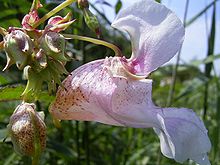
ฺฺBalsam - Ardent love


Balsam meaning: Ardent love

Balsaminaceae (commonly known as the balsam family) are a family of dicotyledonous plants, comprising two genera and 850+ species, all but one of which belong to the genus Impatiens.

The flowering plants may be annual or perennial and are found throughout temperate and tropical regions, including North America, Asia, Europe and Africa. Notable members of the family (all Impatiens) include jewelweed and Busy Lizzie.

Source, Images: http://en.wikipedia.org/wiki/Balsaminaceae

Bachelor button - Celibacy


Bachelor button meanings: Anticipation, celibacy, single blessedness

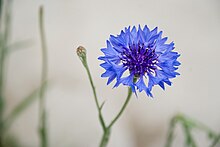
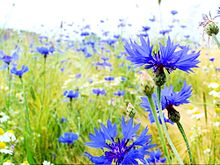
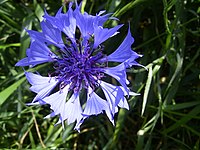
Centaurea cyanus (Cornflower, Bachelor's button, Bluebottle, Boutonniere flower, Hurtsickle, Cyani flower) is a small annual flowering plant in the family Asteraceae, native to Europe. "Cornflower" is also erroneously used for chicory, and more correctly for a few other Centaurea species; to distinguish C. cyanus from these it is sometimes called Common Cornflower. It may also be referred to as basketflower, though the term properly refers to the Plectocephalus group of Centaurea, which is probably a distinct genus.

It is an annual plant growing to 16-35 inches tall, with grey-green branched stems. The leaves are lanceolate, 1–4 cm long. The flowers are most commonly an intense blue colour, produced in flowerheads (capitula) 1.5–3 cm diameter, with a ring of a few large, spreading ray florets surrounding a central cluster of disc florets. The blue pigment is protocyanin, which in roses is red.

In the past it often grew as a weed in crop fields, hence its name (fields growing grains such as wheat, barley, rye, or oats are sometimes known as corn fields in the UK). It is now endangered in its native habitat by agricultural intensification, particularly over-use of herbicides, destroying its habitat; in the United Kingdom it has declined from 264 sites to just 3 sites in the last 50 years. In reaction to this, the conservation charity Plantlife named it as one of 101 species it would actively work to bring 'Back from the Brink'. It is also, however, through introduction as an ornamental plant in gardens and a seed contaminant in crop seeds, now naturalized in many other parts of the world, including North America and parts of Australia.

Cultivation
It is grown as an ornamental plant in gardens, where several cultivars have been selected with varying pastel colours, including pink and purple. Centaurea is also grown for the cutflower industry in Canada for use by florists. The most common colour variety for this use is a doubled blue variety such as 'Blue Boy' or 'Blue Diadem'. White, pink, lavender and black (actually a very dark maroon) are also used but less commonly. It is also occasionally used as a culinary ornament. Cornflowers have been used and prized historically for their blue pigment. Cornflowers are often used as an ingredient in some tea blends and herbal teas, and is famous in the Lady Grey blend of Twinings. Wild cornflower floral water is produced in Provence, France. It is obtained by steam distillation which can be used as a natural mild astringent and antiseptic to prevent eye infections as well as an alcohol-free natural toner. A relative, Centaurea montana, is a perennial plant which is also cultivated as a garden plant. Cornflowers germinate quickly after planting.

Light requirements: full sun. Water requirements: high-average water daily. Soil pH requirements: neutral (6.6-7.5) to mildly alkaline (7.6-7.8).

It flowers from June until August. The cornflower is considered a beneficial weed, and its edible flower can be used to add colour to salads.

Folklore and symbolism
In folklore, cornflowers were worn by young men in love; if the flower faded too quickly, it was taken as a sign that the man's love was not returned.

In herbalism, a decoction of cornflower is effective in treating conjunctivitis, and as a wash for tired eyes.

The blue cornflower has been the national flower of Estonia since 1968 and symbolizes daily bread to Estonians. It is also the symbol of the Estonian political party, People's Union, the Finnish political party, National Coalition Party, and the Swedish political party, Liberal People's Party, and has since the dawn of the 20th century been a symbol for social liberalism there. It is the official flower of the Swedish province of Östergötland.

The blue cornflower is also one of the national flowers of Germany. This is partly due to the story that when Queen Louise of Prussia was fleeing Berlin and pursued by Napoleon's forces, she hid her children in a field of cornflowers and kept them quiet by weaving wreaths for them from the flowers. The flower thus became identified with Prussia, not least because it was the same color as the Prussian military uniform. After the unification of Germany in 1871, it went on to become a symbol of the country as a whole. For this reason, in Austria the blue cornflower is a political symbol for pan-German and rightist ideas. Members of the Freedom Party wore it at the opening of the Austrian parliament in 2005.

It was also the favourite flower of Louise's son Kaiser Wilhelm I. Because of its ties to royalty, authors such as Theodor Fontane have used it symbolically, often sarcastically, to comment on the social and political climate of the time.

The cornflower is also often seen as an inspiration for the German Romantic symbol of the Blue Flower. Due to its traditional association with Germany, the cornflower has been made the official symbol of the annual German-American Steuben Parade.

In France the Bleuet de France is the symbol of the 11th November 1918 armistice and, as such, a common symbol for veterans (especially the now defunct poilus of  World War I), similar to the poppies worn in the United Kingdom and in Canada.

The cornflower is also the symbol for motor neurone disease and amyotrophic lateral sclerosis. Cornflowers are sometimes worn by Old Harrovians.

It was the favorite flower of John F. Kennedy and was worn by his son, John F. Kennedy, Jr. at his wedding in tribute to his father.

Cornflowers were also used in the funeral wreath made for Pharaoh Tutankhamun.


Source, Images: http://en.wikipedia.org/wiki/Cornflower

Baby's Breath - Innocence


Baby’s breath meanings: Festivity, innocence, pure of heart


Gypsophila commonly known as baby's-breath in the United States and Canada, "soap wort" in the United Kingdom, elsewhere Gypsophila—is a genus of about 100 species of flowering plants in the family Caryophyllaceae, native to Europe, Asia and North Africa. Many species are found on calcium-rich soils, including gypsum, hence the name of the genus. Some species are also sometimes called "baby's breath" or simply, "Gyp", among the floral industry. Its botanical name means "lover of chalk", which is accurate in describing the type of soil in which this plant grows.

Originally from Eastern Europe, its natural habitat is on the Steppes in dry, sandy and stony places, often on calcareous soils (gypsophila = "chalk-loving"). Specimens of this plant were first sent to Linnaeus from St Petersburg by the Swiss-Russian botanist Johann Amman. It is cultivated in Peru corresponding to a large portion of this country's flowers exports. 

They are herbaceous annual and perennial plants growing to 5–120 cm tall. The leaves are opposite, linear to narrow triangular, often falcate (sickle-shaped), 1–7 cm long and 2–8 mm broad. The flowers are produced in large inflorescences, which may be either dense or open and lax; each flower is small, 3–10 mm diameter, with five white or pink petals.

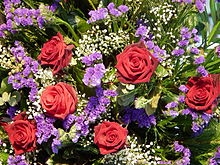
Gypsophilas are often grown as ornamental plants in gardens; they are grown both as garden plants and also valuable as a cut flower in floristry to add as a filler to flower bouquets. The most commonly encountered in gardens are G. paniculata (a perennial species), G. elegans, and G. muralis (both annual species). They are easily propagated from seed, by cuttings, or by root division before growth starts in the spring. Starting as a tiny seed, the annuals and perennials germinate in ten to fifteen days, and can grow rapidly up to 50 cm in height. While they prefer full sun, along with rich, light soil, deficiencies in poor soil constitution can be overcome by adding a general purpose fertilizer, as long as it is well drained.

Gypsophila paniculata is now widely distributed in North America. It is classed as an invasive species in places around the Great Lakes, such as the Sleeping Bear Dunes National Lakeshore and the Chicago region, and in the Pacific Northwest. 

In the United States, it is common for young girls, particularly children attending weddings, to have their hair decorated with Baby's Breath.

Gypsophila paniculata has become an invasive species in parts of North America.
Gypsophila rokejeka is used to provide saponins in the production of halva.

Gypsophila species are used as food plants by the larvae of some Lepidoptera species including three case-bearers of the genus Coleophora which feed on G. fastigiata: C. kyffhusana, C. niveistrigella (both of which feed exclusively on the plant) and C. vicinella.

The root of the Gypsophila repens is used to make the whip cream topping of the Turkish dessert kerebic. Boiling the root over a period of hours produces white bubbles which are collected, mixed with sugar, and mixed until it thickens to a cream.


Source, Images: http://en.wikipedia.org/wiki/Gypsophila