National Flower of Macau - Lotus


The flower representing Macau is lotus, a stylised depiction of which can be seen in the territory's flag.

Nelumbo nucifera, known by a number of names including Indian Lotus, Sacred Lotus, Bean of India, or simply Lotus, is a plant in the monogeneric family Nelumbonaceae. The Linnaean binomial Nelumbo nucifera (Gaertn.) is the currently recognized name for this species, which has been classified under the former names, Nelumbium speciosum (Willd.) and Nymphaea nelumbo, among others. Names other than Nelumbo nucifera (Gaertn.) are obsolete synonyms and should not be used in current works. This plant is an aquatic perennial. Under favorable circumstances its seeds may remain viable for many years, with the oldest recorded lotus germination being from that of seeds 1,300 years old recovered from a dry lakebed in northeastern China.

A common misconception is referring to the lotus as a water lily (Nymphaea), an entirely different plant as can be seen from the center of the flower, which clearly lacks the structure that goes on to form the distinctive circular seed pod in the Nelumbo nucifera. Water lilies come in various colors, whereas the lotus has flowers ranging in hues of white to hot pink.

Native to Tropical Asia and Queensland, Australia, it is commonly cultivated in water gardens. The white and pink lotuses are national flowers of India and Vietnam, respectively. Plant taxonomy systems agree that this flower is in the Nelumbo genus, but disagree as to which family Nelumbo is in, or whether it should be part of its own unique family and order tree.
The roots of Nelumbo nucifera are planted in the soil of the pond or river bottom, while the leaves float on top of the water surface or are held well above it. The flowers are usually found on thick stems rising several centimeters above the leaves. The plant normally grows up to a height of about 150 cm and a horizontal spread of up to 3 meters, but some unverified reports place the height as high as over 5 meters. The leaves may be as large as 60 cm in diameter, while the showy flowers can be up to 20 cm in diameter.

Researchers report that the lotus has the remarkable ability to regulate the temperature of its flowers to within a narrow range just as humans and other warmblooded animals do. Dr. Roger S. Seymour and Dr. Paul Schultze-Motel, physiologists at the University of Adelaide in Australia, found that lotus flowers blooming in the Adelaide Botanic Gardens maintained a temperature of 30–35 °C (86–95 °F), even when the air temperature dropped to 10 °C (50 °F). They suspect the flowers may be doing this to attract coldblooded insect pollinators. The study, published in the journal Nature, is the latest discovery in the esoteric field of heat-producing plants. Two other species known to be able to regulate their temperature include Symplocarpus foetidus and Philodendron selloum.

The traditional Sacred Lotus is distantly related to Nymphaea caerulea and possesses similar chemistry. Both Nymphaea caerulea and Nelumbo nucifera contain the alkaloids nuciferine and aporphine.

The distinctive dried seed heads, which resemble the spouts of watering cans, are widely sold throughout the world for decorative purposes and for dried flower arranging.

The flowers, seeds, young leaves, and "roots" (rhizomes) are all edible. In Asia, the petals are sometimes used for garnish, while the large leaves are used as a wrap for food, not frequently eaten (for example, as a wrapper for zongzi). In Korea, the leaves and petals are used as a tisane. Yeonkkotcha is made with dried petals of white lotus and yeonipcha is made with the leaves. Young lotus stems are used as a salad ingredient in Vietnamese cuisine. The rhizome (called ǒu () in pinyin Chinese, ngau in Cantonese, bhe in Hindi, renkon (レンコン, 蓮根 in Japanese), yeongeun (in Korean) is used as a vegetable in soups, deep-fried, stir-fried, and braised dishes and the roots are also used in traditional Asian herbal medicine. Petals, leaves, and rhizome can also all be eaten raw, but there is a risk of parasite transmission (e.g., Fasciolopsis buski): it is therefore recommended that they be cooked before eating.

Lotus rootlets are often pickled with rice vinegar, sugar, chili and/or garlic. It has a crunchy texture with sweet-tangy flavours. In Asian cuisine, it is popular with salad, prawns, sesame oil and/or coriander leaves. Lotus roots have been found to be rich in dietary fiber, vitamin C, potassium, thiamin, riboflavin, vitamin B6, phosphorus, copper, and manganese, while very low in saturated fat.

The stamens can be dried and made into a fragrant herbal tea called liánhuā cha (蓮花茶) in Chinese, or (particularly in Vietnam) used to impart a scent to tea leaves. The lotus seeds or nuts (called liánzĭ, 蓮子; or xian liánzĭ, 鲜莲子, in Chinese) are quite versatile, and can be eaten raw or dried and popped like popcorn, phool makhana. They can also be boiled until soft and made into a paste, or boiled with dried longans and rock sugar to make a tong sui (sweet soup). Combined with sugar, lotus seed paste becomes one of the most common ingredients used in pastries such as mooncakes, daifuku, and rice flour pudding.

In Vietnam, the bitter tasting germs of the lotus seeds are also made into a tisane (trà tim sen). A unique fabric from the lotus plant fibers is produced only at Inle lake, Union of Myanmar and is used for weaving special robes for Buddha images called kya thingahn (lotus robe).


Source, Images: http://en.wikipedia.org/wiki/Nelumbo_nucifera

National Flower of Hong Kong - Bauhinia blakeana


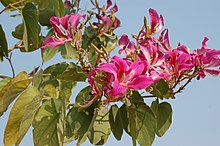
The Bauhinia blakeana, a native species discovered in Hong Kong, is the floral emblem of that territory. It was chosen as the logo of the Urban Council in 1965, and it was later incorporated in the flag and emblem of the Hong Kong Special Administrative Region of the People's Republic of China after the 1997 handover of Hong Kong from the United Kingdom to the People's Republic of China.

Bauhinia blakeana is an orchid tree of the genus Bauhinia with large thick leaves and striking purplish red flowers. The fragrant, orchid-like flowers are usually 10 to 15 centimetres (3.9 to 5.9 in) across, and bloom from early November to the end of March. Although now cultivated in many areas, it originated in Hong Kong in 1880 and apparently all of the cultivated trees derive from one cultivated at the Hong Kong Botanic Gardens and widely planted in Hong Kong starting in 1914. It is referred to as bauhinia in non-scientific literature though this is the name of the genus. It is sometimes called the Hong Kong orchid.

The Bauhinia double-lobed leaf is similar in shape to a heart, or a butterfly. A typical leaf is 7 to 10 centimetres (2.8 to 3.9 in) long and 10 to 13 centimetres (3.9 to 5.1 in) wide, with a deep cleft dividing the apex. Local people call the leaf "clever leaf", and regard it as a symbol of cleverness. Some people use the leaves to make bookmarks in the hope that the bookmarks will bring them good luck in their studies.

It is sterile (does not produce seed), and is a hybrid between Bauhinia variegata and Bauhinia purpurea. Propagation is by cuttings and air-layering, and the tree prefers a sheltered sunny position with good soil. As it is only known in cultivation, it can also be named as a cultivar: Bauhinia 'Blakeana'.

This tree was discovered in around 1880 near the ruins of a house on above the shore-line of western Hong Kong island near Pok Fu Lam and propagated to the formal botanical gardens in Victoria/Central. It was later named for Sir Henry Blake, British Governor of Hong Kong, from 1898 to 1903 who was a keen amateur botanist, by the man who made the first thorough scientific description of the 'Hong Kong orchid tree' S. T. Dunn, Superintendent of the Botanical and Forestry Department, who assigned it to the genus Bauhinia and named it after Blake in his paper of 1908.

Bauhinia blakeana was adopted as the floral emblem of Hong Kong by the Urban Council in 1965. Since 1997 the flower appears on Hong Kong's coat of arm, its flag and its coins; its Chinese name has also been frequently shortened as 紫荊/ ( yáng means "foreign" in Chinese, and some may consider this would be deemed inappropriate by the PRC government), although 紫荊/ refers to another genus called Cercis. A statue of the plant has been erected in Golden Bauhinia Square in Hong Kong.

Although the flowers are bright pinkish purple in colour, they are depicted in white on the Flag of Hong Kong. The endemic plant of Hong Kong was introduced to Taiwan in 1967. In 1984 it was chosen to be the city flower of Chiayi City, in southwestern Taiwan.


Source, Images: http://en.wikipedia.org/wiki/Bauhinia_blakeana

National Flower of China - Peony


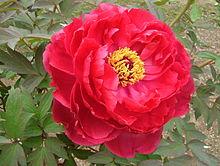
China currently has no official national flower. Traditionally, various regions have different designations where national symbols are concerned. In 1903, the Qing Dynasty named the peony (Paeonia suffruticosa) the floral emblem of the nation. The peony has long been considered a flower of wealth and honor in China.

The plum blossom meihua (Chinese: méihuā) has been long held as one of the most beloved flowers in Chinese culture. The Republic of China government named the plum blossom as the national flower in 1964. The plum blossom is symbol for resilience and perseverance in the face of adversity, because plum blossoms often bloom most vibrantly even amidst the harsh winter snow.

The People's Republic of China, which has controlled mainland China since 1949, has no official floral emblem. There have been several petitions in recent years to officially adopt one. However, the government has not taken any action yet. A poll in 2005 showed that 41% of the public supports peony as the national flower while 36% supported the plum blossom. Some scholars have suggested that the peony and plum blossoms may be designated as dual national flowers. The orchids and chrysanthemum have also been held as possible floral symbols of China, along with the peony and plum blossoms.

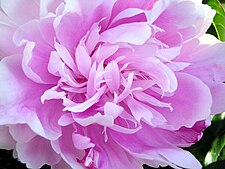
Peony or paeony is a name for plants in the genus Paeonia, the only genus in the flowering plant family Paeoniaceae. They are native to Asia, southern Europe and western North America. Boundaries between species are not clear and estimates of the number of species range from 25 to 40.

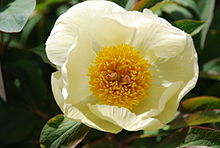
Most are herbaceous perennial plants 1.5 - 5 feet (0.5 - 1.5 metres) tall, but some resemble trees up to 5 - 10 feet (1.5 – 3 metres) tall. They have compound, deeply lobed leaves, and large, often fragrant flowers, ranging from red to white or yellow, in late spring and early summer. The peony is named after Paeon (also spelled Paean), a student of Asclepius, the Greek god of medicine and healing. Asclepius became jealous of his pupil; Zeus saved Paeon from the wrath of Asclepius by turning him into the peony flower.

The family name "Paeoniaceae" was first used by Friedrich K.L. Rudolphi in 1830, following a suggestion by Friedrich Gottlieb Bartling that same year. The family had been given other names a few years earlier. The composition of the family has varied, but it has always consisted of Paeonia and one or more genera that are now placed in Ranunculales. It has been widely believed that Paeonia is closest to Glaucidium, and this idea has been followed in some recent works. Molecular phylogenetic studies, however, have demonstrated conclusively that Glaucidium belongs in Ranunculaceae, but that Paeonia belongs in the unrelated order Saxifragales.

Peonies can be classified by both plant growth habit and by flower type. Plant growth types are Herbaceous (Bush), Tree, and Intersectional (Itoh). Each flower type becomes more complex in its arrangement of petals. The flower types include Single (e.g., Athena, Dad, Krinkled White, Scarlet O’Hara, Sea Shell), Japanese (Nippon Beauty, Madame Butterfly), Anemone, Semi-Double (Paula Fay, Coral Charm, Miss America, Buckeye Belle), Double (Ann Cousins, Gardenia, Kansas, Paul M. Wild, Tourangelle) and Bomb-Double (Red Charm, Raspberry Sundae, Mons Jules Elie). Herbaceous peonies die back in winter and regrow in spring, while tree peonies lose their leaves in winter, but leave woody stems.

Intersectional (Itoh) peonies are hybrid crosses between tree and herbaceous types. They have the large flowers of a tree peony, but die back to the ground each year like herbaceous peonies.

Symbolism and uses
The peony is among the longest-used flowers in ornamental culture and is one of the smallest living creature national emblems in China. Along with the plum blossom, it is a traditional floral symbol of China, where the Paeonia suffruticosa is called 牡丹 (mǔdān). It is also known as 贵花 (fùguìhuā) "flower of riches and honour," and is used symbolically in Chinese art. In 1903, the Qing Dynasty declared the peony as the national flower. Currently, the Republic of China on Taiwan designates the plum blossom as the national flower, while the People's Republic of China has no legally designated national flower. In 1994, the peony was proposed as the national flower after a nationwide poll, but the National People's Congress failed to ratify the selection. In 2003, another selection process has begun, but to date, no choice has been made.

The famous ancient Chinese city Luoyang has a reputation as a cultivation centre for the peonies. Throughout Chinese history, peonies in Luoyang are often said to be the finest in the country. Dozens of peony exhibitions and shows are still held there annually.

In Japan, Paeonia lactiflora used to be called ebisugusuri ("foreign medicine"). In kampo (the Japanese adaptation of Chinese medicine), its root was used as a treatment for convulsions. It is also cultivated as a garden plant. In Japan Paeonia suffruticosa is called the "King of Flowers" and Paeonia lactiflora is called the "Prime Minister of Flowers."

Pronunciation of 牡丹 (peony) in Japan is "botan." Before the Meiji period, meat taken from quadrupeds was seldom consumed in Japan due to Buddhism. Thus in cases where such meat was handled, it was paraphrased using the names of flowers. The term botan was used (and is still used) to paraphrase wild boar meat. This comes from the flowery resemblance of the sliced meat when spread over a dish. Another example is sakura (cherry blossoms) which stands for horsemeat.

In 1957, the Indiana General Assembly passed a law to make the peony the state flower of Indiana, a title which it holds to this day. It replaced the zinnia, which had been the state flower since 1931. Mischievous nymphs were said to hide in the petals of the Peony, giving it the meaning of Shame or Bashfulness in the Language of Flowers. While the peony takes several years to re-establish itself when moved, it blooms annually for decades once it has done so.

Peonies are also extensively grown as ornamental plants for their very large, often scented flowers. Peonies tend to attract ants to the flower buds. This is due to the nectar that forms on the outside of the flower buds, and is not required for the plants' own pollination or other growth.

Peonies are a common subject in tattoos, often used along with koi-fish. The popular use of peonies in Japanese tattoo was inspired by the ukiyo-e artist Utagawa Kuniyoshi's illustrations of the Suikoden, a serialized novel from China. His paintings of warrior-heroes covered in pictorial tattoos included lions, tigers, dragons, koi fish, and peonies, among other symbols. The peony became a masculine motif, associated with a devil-may-care attitude and disregard for consequence.


Source, Images: http://en.wikipedia.org/wiki/Peony

National Flower of Sri Lanka - Blue Water Lily


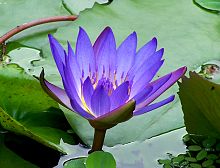
Sri Lanka - Nil Mānel, Water Lily (Nymphaea stellata). Although "Nil" means ‘blue’ in Sinhala, the Sinhalese name of this plant is often rendered as "Water Lily" in English. 
This beautiful aquatic flower appears in the Sigiriya frescoes and has been mentioned in Sanskrit, Pali and Sinhala literary works since ancient times under the names "Kuvalaya", "Indhīwara", "Niluppala", "Nilothpala" and "Nilupul" as a symbol of virtue, discipline and purity. Buddhist lore in Sri Lanka claims that this flower was one of the 108 auspicious signs found on Prince Siddhartha's footprint.

Nymphaea nouchali, commonly known as the Red and blue water lily, Blue star water lily, Star lotus, or by its synonym Nymphaea stellata, is a water lily of genus Nymphaea.
This aquatic plant is native to the Indian Subcontinent area. It was spread to other countries already in ancient times and has been long valued as a garden flower in Thailand and Myanmar to decorate ponds and gardens. In its natural state the Red and blue water-lily is found in static or slow-flowing aquatic habitats of little to moderate depth.

Description
Nymphaea nouchali is a day blooming non-viviparous plant with submerged roots and stems. Part of the leaves are submerged, while others rise slightly above the surface. The leaves are round and green on top; they usually have a darker underside. The floating leaves have undulating edges that give them a crenellate appearance. Their size is about 20–23 cm and their spread is 0.9 to 1.8 m.

This water-lily has a beautiful flower which is usually violet blue in color with reddish edges. Some varieties have white, purple, mauve or fuchsia-colored flowers. The flower has 4-5 sepals and 13-15 petals that have an angular appearance making the flower look star-shaped from above. The cup-like calyx has a diameter of 11–14 cm.

Symbolism
Nymphaea nouchali is the National flower of Bangladesh (where it is known as "Shapla") and Sri Lanka (where it is known as Nil Mānel or "Nil Mahanel"). Since "Nil" means ‘blue’ in Sinhala, the Sinhalese name of this plant is often rendered as "blue lotus" in English.

In Sri Lanka this plant usually grows in buffalo ponds and natural wetlands. Its beautiful aquatic flower has been mentioned in Sanskrit, Pali and Sinhala literary works since ancient times under the names "Kuvalaya", "Indhīwara", "Niluppala", "Nilothpala" and "Nilupul" as a symbol of virtue, discipline and purity. Buddhist lore in Sri Lanka claims that this flower was one of the 108 auspicious signs found on Prince Siddhartha's footprint. It is said that when Buddha died, lotus flowers blossomed everywhere he had walked in his lifetime. The star lotus might have been one of the plants eaten by the Lotophagi of Homer's Odyssey.

The Red and blue water-lily is used as an ornamental plant because of its spectacular flowers. It is also popular as an aquarium plant under the name "Dwarf Lily" or "Dwarf Red Lily". Sometimes it is grown for its flowers, while other aquarists prefer to trim the lily pads, and just have the underwater foliage.

Nymphaea nouchali is considered a medicinal plant in Indian Ayurvedic medicine under the name Ambal; it was mainly used to treat indigestion. Recent experiments have confirmed that it has medicinal qualities as an antihepatotoxic and antidiabetic. Like all water lilies or lotuses, its tubers and rhizomes can be used as food items; they are eaten usually boiled or roasted. In the case of the Red and blue water-lily, its tender leaves and flower peduncles are also valued as food. The dried plant is collected from ponds, tanks and marshes during the dry season and used in India as animal forage.

The white water lily is the national flower of Bangladesh and State flower for Andhra Pradesh, India. The Blue water lily is the national flower of Sri Lanka. It is also the birth flower for July.


Source, Images: http://en.wikipedia.org/wiki/Nymphaea_stellata

National Flower of Pakistan - Poet's Jasmine


The National symbols of the country constituting the nation-state such as the Poet's Jasmine (National flower of Pakistan) and Rhododendron the (State flower) and the Chinar (State tree) in the Regional state of Jammu and Kashmir (disputed territory), Deodar (National tree of Pakistan), Mango (National fruit of Pakistan).

Jasminum officinale (Common Jasmine, Poet's Jasmine, Jessamine) is a species of jasmine, in the family Oleaceae, famous for its scent.

Jasminum officinale is so ancient in cultivation that its country of origin, though somewhere in Central Asia, is not certain. H.L. Li, The Garden Flowers of China, notes that in the third century CE, jasmines identifiable as J. officinale and J. sambac were recorded among "foreign" plants in Chinese texts, and that in ninth century Chinese texts J. officinale was said to come from Byzantium. Its Chinese name, Yeh-hsi-ming is a version of the Persian and Arabic name.

Its entry into European gardens was most likely through the Arab-Norman culture of Sicily, but, as the garden historian John Harvey has said, "surprisingly little is known, historically or archaeologically, of the cultural life of pre-Norman Sicily". In the mid-14th century the Florentine Boccaccio in his Decameron describes a walled garden in which "the sides of the alleys were all, as it were, walled in with roses white and red and jasmine; insomuch that there was no part of the garden but one might walk there not merely in the morning but at high noon in grateful shade." Jasmine water also features in the story of Salabaetto in the Decameron. Jasminum officinale, "of the household office" where perfumes were distilled, was so thoroughly naturalized that Linnaeus thought it was native to Switzerland. As a garden plant in London it features in William Turner's Names of Herbes, 1548.

Double forms, here as among many flowers, were treasured in the 16th and 17th centuries. It is widely recognized as the National flower of Pakistan.


Source, Images: http://en.wikipedia.org/wiki/Jasminum_officinale