Aconitum (A-co-ní-tum), known as aconite, monkshood, wolfsbane, leopard's bane, women's bane, Devil's helmet or blue rocket, is a genus of over 250 species of flowering plants belonging to the buttercup family (Ranunculaceae). The name comes from ἀκόνιτον meaning without struggle.
These herbaceous perennial plants are chiefly natives of the mountainous parts of the northern hemisphere, growing in moisture retentive but well draining soils on mountain meadows. Their dark green leaves lack stipules. They are palmate or deeply palmately lobed with 5–7 segments. Each segment again is 3-lobed with coarse sharp teeth. The leaves have a spiral or alternate arrangement. The lower leaves have long petioles.
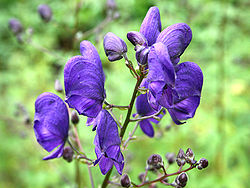
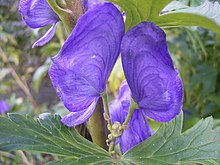
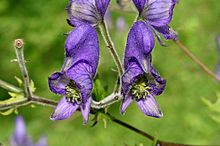
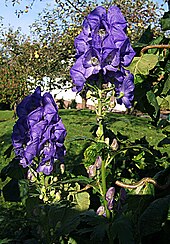
 The tall, erect stem is crowned by racemes of large blue, purple, white, yellow or pink zygomorphic flowers with numerous stamens. They are distinguishable by having one of the five petaloid sepals (the posterior one), called the galea, in the form of a cylindrical helmet; hence the English name monkshood. There are 2–10 petals, in the form of nectaries. The two upper petals are large. They are placed under the hood of the calyx and are supported on long stalks. They have a hollow spur at their apex, containing the nectar. The other petals are small and scale-like or non-forming. The 3–5 carpels are partially fused at the base.
The fruit is a follicle, a follicle being a dry, unilocular, many-seeded fruit formed from one carpel, and dehiscing by the ventral suture in order to release seeds.
Uses
 The roots of Aconitum ferox supply the Nepalese poison called bikh, bish, or nabee. It contains large quantities of the alkaloid pseudaconitine, which is a deadly poison. Aconitum palmatum yields another of the bikh poisons. The root of Aconitum luridum, of the Himalaya, is said to be as poisonous as that of A. ferox or A. napellus.
Several species of Aconitum have been used as arrow poisons. The Minaro in Ladakh use A. napellus on their arrows to hunt ibex, while the Ainu in Japan used a species of Aconitum to hunt bear. The Chinese also used Aconitum poisons both for hunting and for warfare.
Many species of Aconitum are cultivated in gardens, having either blue or yellow flowers.
 Aconitum lycoctonum (Alpine wolfsbane) is a yellow-flowered species common in the Alps of Switzerland. As garden plants the aconites are very ornamental, hardy perennial plants. They thrive in the garden soils, and will grow in the shade of trees. They are easily propagated by divisions of the root or by seeds; care should be taken not to leave pieces of the root where livestock might be poisoned.
 The most common plant in this genus, Aconitum napellus (the Common Monkshood) was considered in the past to be of therapeutic and of toxicological importance. Its roots have occasionally been mistaken for horseradish. When touched to one's lip, the juice of the aconite root produces a feeling of numbness and tingling. This plant is used as a food plant by some Lepidoptera species including Dot Moth, The Engrailed, Mouse Moth, Wormwood Pug, and Yellow-tail.
Aconite produced from the roots of a number of different species of Aconitum is used ethnomedically in traditional Chinese medicine (TCM), to treat "coldness", general debility, and "Yang deficiency". Misuse of the medicinal ingredients contained in this plant can negatively affect the cardiovascular and central nervous systems, thus resulting in death.
Cultural depictions: Film and Television
 In an episode of Home Improvement wolfsbane is given to Tim by Wilson to help him ward off the bad luck he has been experiencing as a presumed result of throwing out a chain letter.
Aconite is also used as a poison in Midsomer Murders, in the episode "Garden of Death".
In the 1931 film Dracula, Wolfsbane is used to keep Dracula out of households.
Monkshood is used as a plot device in the movie Ginger Snaps, as a means of treating lycanthropy.
In the 1998 play and 2005 film written by Craig Lucas, The Dying Gaul, the main character uses the root of a monkshood plant to attempt to poison his lover's wife.
In the British TV series Heartbeat, in the first episode of series 8 (1998), the poisonings are eventually found to be due to common monkshood root mistaken for horseradish and made into sauce in the pub.
 In the television series The Vampire Diaries, Aconitum Vulperia (wolfsbane) is highly toxic to werewolves, similar to the poisonous effects that vervain has on vampires.
Monkshood was used to poison a teenager in episode 3 ("Sympathy for the Devil") of the TV series Rizzoli & Isles.
In the new MTV show Teen Wolf, Wolfsbane is used to hide the true identity of the human side in a werewolf. Also a rare form of Monkshood called Nordic Blue Monkshood is extremely toxic to werewolves in the sense that exposure to the plant will kill them over time, and force transformations.
 Aconite or wolf's bane was used by the young magician Merlin in an attempt to poison King Arthur whilst he (Merlin) was under enchantment to the will of the witch Morgana, in an episode of Merlin (series 4) called "A Servant of Two Masters".
Wolf's bane was used in the pilot episode of Grimm by detective Nick Burkhardt to cover his scent while sneaking up on a 'Blutbad', the series equivalent of a traditional werewolf.
Source, Images: http://en.wikipedia.org/wiki/Aconitum

 The fruit of the almond is not a true nut, but a drupe, consisting of an outer hull and a hard shell with the seed ("nut") inside. Shelling almonds refers to removing the shell to reveal the seed. Almonds are commonly sold shelled (i.e., after the shells are removed), or unshelled (i.e., with the shells still attached). Blanched almonds are shelled almonds that have been treated with hot water to soften the seedcoat, which is then removed to reveal the white embryo.
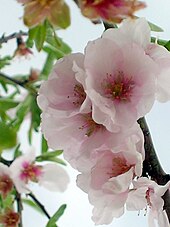
 The almond is a small deciduous tree, growing 4–10 metres (13–33 ft) in height, with a trunk of up to 30 centimetres (12 in) in diameter. The young twigs are green at first, becoming purplish where exposed to sunlight, then grey in their second year. The leaves are 3–5 inches long, with a serrated margin and a 2.5 cm (1 in) petiole. The flowers are white or pale pink, 3–5 cm (1–2 in) diameter with five petals, produced singly or in pairs before the leaves in early spring.
  The almond fruit measures 3.5–6 cm (1–2 in) long. In botanical terms it is not a nut, but a drupe. The outer covering or exocarp, fleshy in other members of Prunus such as the plum and cherry, is instead a thick leathery grey-green coat (with a downy exterior), called the hull. Inside the hull is a reticulated hard woody shell (like the outside of a peach pit) called the endocarp. Inside the shell is the edible seed, commonly called a nut. Generally, one seed is present, but occasionally there are two.








.jpg/170px-Acacia_saligna(03).jpg)